
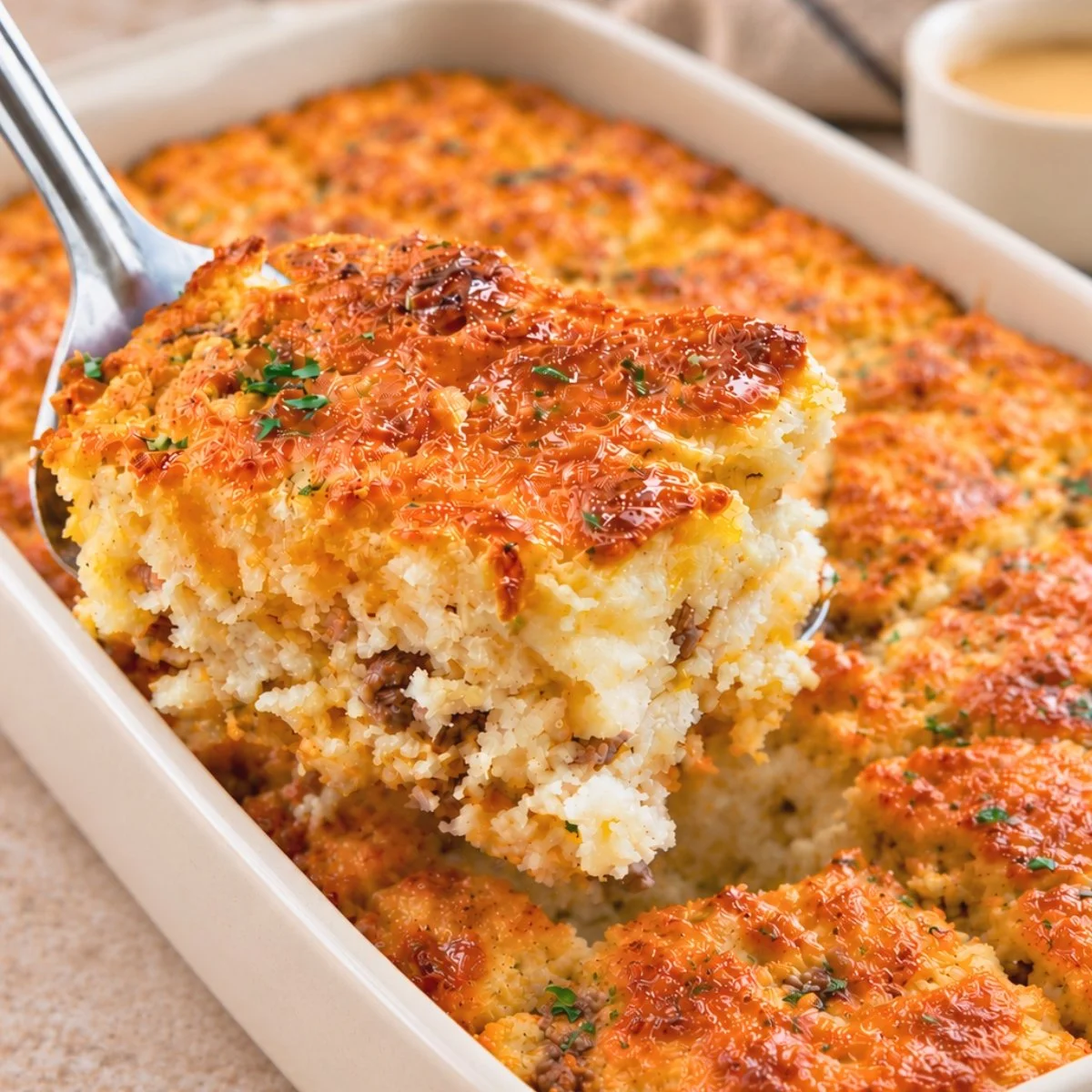
Butter swim biscuits skip the part where you cut cold butter into flour. Instead, the dough goes into a pan with melted butter already waiting, and the oven does the rest. This version folds browned breakfast sausage and cheddar into a soft buttermilk dough, then brushes the hot biscuits with maple butter. The edges brown, the centers stay tender, and the sausage and cheese show up in every bite. No rolling, no cutting in butter, no fuss.
The dough should be thick, sticky, and soft enough to spread with a spatula. If you keep adding flour until it feels like traditional biscuit dough, the texture changes. Drain the cooked sausage well, spread the dough evenly, and check the center before pulling the pan from the oven. A browned top does not tell you whether the middle is baked.
Recipe Details
- Prep time: 15 minutes
- Cook time: About 35 minutes, including browning the sausage
- Rest time: 10 minutes
- Total time: About 1 hour
- Yield: 8 large biscuits
- Estimated calories: 470 per biscuit, including maple butter
Ingredients
For the Biscuits
- ½ pound (227 g) bulk pork breakfast sausage
- 2½ cups (313 g) all-purpose flour, spooned into the measuring cup and leveled
- 4 teaspoons (16 g) baking powder
- ¾ teaspoon (about 4 g) fine salt
- 1 tablespoon (13 g) granulated sugar
- ½ teaspoon ground black pepper
- 1 cup (4 ounces / 113 g) shredded medium cheddar cheese
- 2 cups (490 g) cultured buttermilk
- ½ cup (1 stick / 113 g) unsalted butter, melted
For the Maple Butter
- 2 tablespoons (28 g) unsalted butter, melted
- 2 tablespoons (30 ml) pure maple syrup
Instructions
-
Heat the oven and prepare the pan. Set your rack in the middle of the oven and preheat it to 450°F (230°C). Lightly grease a 7 × 11-inch (18 × 28 cm) baking dish rated for that temperature. A light-colored metal pan works well; check the manufacturer’s temperature limit if using ceramic or glass.
-
Brown and drain the sausage. Cook the sausage in a skillet over medium heat, breaking it into small crumbles. Let the pieces develop some browned edges and cook the pork to 160°F (71°C). Transfer to a paper towel-lined plate, leaving the rendered fat in the skillet. Cool for about 5 minutes while preparing the other ingredients.
-
Combine the dry ingredients. Whisk the flour, baking powder, salt, sugar, and pepper in a large bowl, breaking up any lumps of baking powder. Toss in the cheddar and drained sausage so they are distributed through the flour.
-
Stir in the buttermilk. Add the buttermilk and fold with a sturdy spatula, scraping the bottom of the bowl. Stop when there are no pockets of dry flour. The dough will be wet and sticky, with a rough surface. Avoid beating it smooth or adding extra flour to make it easier to handle.
-
Spread over the butter. Pour the melted ½ cup of butter into the prepared dish. Add the dough in several spoonfuls across the pan, then gently spread it into an even layer. Some butter will rise around the edges and over the dough. Leave it there.
-
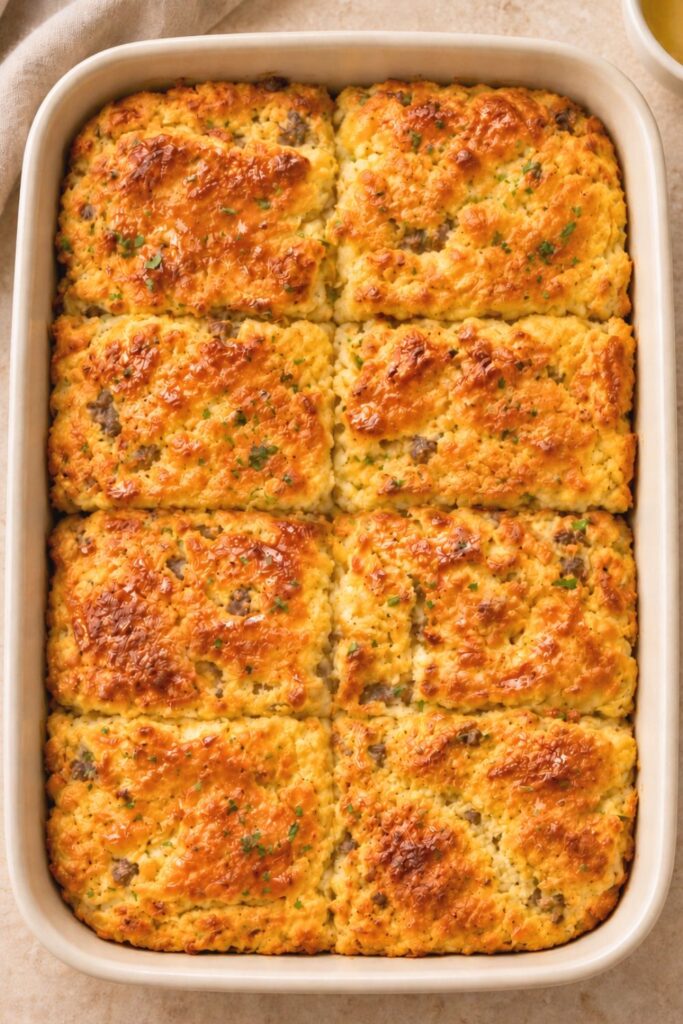
Mark the portions. Lightly grease a knife or bench scraper and press through the dough to mark 8 portions in 2 rows of 4. The soft dough may partially close over the lines. These marks are guides for cutting after baking.
-
Bake until the center is set. Bake for approximately 26–30 minutes. Start watching the color around 20 minutes and loosely cover with foil if the tops are getting dark. The edges should be deeply golden and the center should feel set. A skewer inserted into the center biscuit should come out without sticky raw dough; melted cheese or a little butter on the skewer is fine. If the middle is still wet, continue baking and check again after a few minutes.
-
Brush and rest. Whisk together the 2 tablespoons of melted butter and maple syrup. Brush evenly over the hot biscuits, stirring the mixture again if it separates. Rest in the pan for 10 minutes so the crumb firms up and some of the butter can soak in. Cut along the marked lines and lift out with a spatula.
What to Serve with Them
Serve warm with scrambled eggs and fresh fruit. For a savory version with sausage gravy, leave off the maple butter. You can also skip the glaze and put apple butter on the table for anyone who wants a sweet topping.
Ingredient Notes and Substitutions
Use bulk breakfast sausage or remove the casings from uncooked breakfast links. Mild or hot sausage both work. For turkey breakfast sausage, cook it to 165°F (74°C) before mixing it into the dough.
Sharp cheddar can replace the medium cheddar in the same amount. Use unsalted butter because the sausage, cheese, and baking powder already contribute salt. The salt measurement here is for fine salt; kosher salt crystals vary by brand.
Use cultured buttermilk for its tang and body. Plain milk is thinner and changes the consistency of this already soft dough.
If the Biscuits Seem Wet or Greasy
Butter bubbling around the edges is expected. Give the biscuits their full resting time before serving. A sticky, raw center needs more oven time; resting cannot finish baking raw dough. Loosely cover the browned top with foil and return the pan to the oven until set.
Drain the sausage so its rendered fat does not add to the butter already measured. For heavy biscuits that are fully baked, check the freshness of the baking powder and avoid mixing past the point where the flour disappears.
Pan Size
The listed timing is for a 7 × 11-inch dish. A 9 × 9-inch pan has a similar surface area, though timing may change. A 9 × 13-inch dish makes thinner biscuits; an 8 × 8-inch dish makes a deeper layer. Check the center carefully whenever you change pans.
Make Ahead and Storage
Cook and drain the sausage the day before, refrigerate it promptly, and shred the cheese. You can also whisk the dry ingredients together separately. Add the buttermilk when the oven is ready; preparing the wet dough the night before can affect its rise.
Refrigerate these sausage-filled biscuits within 2 hours of baking, or within 1 hour above 90°F (32°C). Store covered at 40°F (4°C) or below. Use within 3–4 days of cooking the sausage, including any prep-ahead time.
For longer storage, wrap individual cooled biscuits and freeze in a freezer bag for up to 2 months for best quality. Thaw overnight in the refrigerator.
Reheat loosely wrapped in foil at 350°F (175°C). Begin checking after 15 minutes and continue until the center reaches 165°F (74°C). Open the foil near the end to firm up the edges. Microwaving in short intervals gives a softer result; check that the center reaches the same temperature.